錫米才胡椒肉骨茶

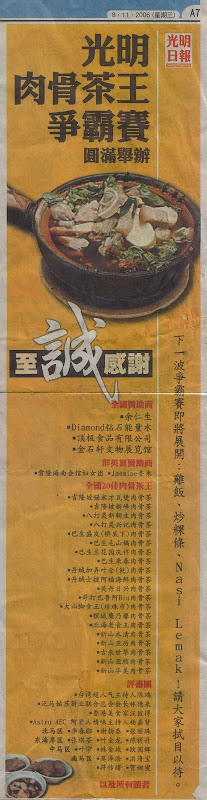
錫米才胡椒肉骨茶,至今已是二十多年的老招牌。可說是全馬第一家首創胡椒肉骨茶。而在2006年,有幸被選為〈全囯20大光明肉骨茶王〉。 曾經擁有數錫礦場的老板。在1986年的世界錫价大跌,縱然依依不舍,還是被逼揮別陪伴他大半生的錫礦場而轉行設店。開始售賣偏愛吃的胡椒肉骨茶,並以自己的綽號“錫米才”命名。 因此在店家的心目中,錫米和胡椒肉骨茶的關係又如父子般。諾不是因爲錫礦業,恐怕就沒有這家胡椒肉骨茶店了。 會以胡椒做湯底,除了別有傳統的肉骨茶以外,主要是迎合不同体質的人對吸收葯材有不同的反應。 胡椒性質溫和,除了擁有暖胃的作用同時也備有除腥增鮮的本能。 本店采用上等胡椒和頂級果皮煮成的胡椒肉骨茶,因此在溫醇适中之餘,還多了一份挑逗食慾的辣味。 除了招牌胡椒肉骨茶,當然少不了顧客愛吃客家菜式的梅菜扣肉,瓦煲黃酒雞,姜鴨,豬腳醋,醬蒸金鳳等及配上一碗傳統的福建介菜飯,就更加的回味無窮了。 特別介紹另一道主題,是與木材燒和鹽燴熟的,鹽焗雞。這一道菜只有在周末及周日才有出售。“會是以一完整的雞上桌,沒有切開,客人就會以手把雞只撕開,這樣是爲了保持雞只的汁不會乾枯,肉質鮮嫩。”

Saturday, August 23, 2008

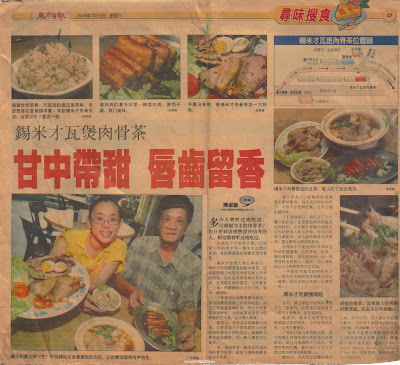
[媒体访问]锡米才瓦煲肉骨茶 甘中带甜 唇齿留香

锡米才瓦煲肉骨茶
甘中带甜 唇齿留香 (东方日报2005年7月16日,寻味搜食)
陈淑莹报道

多少人曾听过或吃过,以胡椒为主的肉骨茶?但只要到访或者熟悉沙叻秀的人,相信都曾听过或吃过。
这间位于沙叻秀大街,已经经营19年的老字号--锡米才瓦煲肉骨茶,其招牌菜就是胡椒瓦煲肉骨茶。
锡米才负责人曾立萍表示,锡米才的招牌菜是胡椒肉骨茶,这道菜特别之处是完全没有放入任何的药材,但吃起来却是辣中带有甘甜,若是能吃辣的朋友,当肉骨茶一上桌,热腾腾的大口大口吃,别有一番滋味。
“本店会以肉骨茶做为买点,因为肉骨茶是锡工们所常吃的,而且父亲也曾是锡矿家,所以对肉骨茶特别钟爱,当时肉骨茶也是苦力们所称的乞丐菜,以大骨头熬煮。”
她表示,该店会以胡椒做为汤底,主要是因为不同体质的人对吸收药材都有不同的反应,胡椒的主要功能是暖胃,对一般人都是可以接受。
另一道招牌菜—梅菜扣肉是妈妈的拿手好菜,做法和调味料都是秘方不外传。
曾立萍表示,吃梅菜扣肉就是不要怕肥肉,因为该店的扣肉吃了,不但不会觉得肥腻,反而会越吃越有味。
“不是我夸口,我吃过了不少餐厅的扣肉,还是觉得妈妈的梅菜扣肉好吃,许多餐厅都做不到使五花肉的肥肉入味及好味,而且扣肉是注重肥肉,因为能使菜肴色泽鲜美,要让肥肉入围也是要诀。”
在锡米才才能找到的芥菜饭是传统的福建菜,内有芥菜、虾米、烧肉等材料,首先将饭炒一会,再将材料全部放入一起炒,加入调味料以小火焖煮即可大功告成。
“芥菜樊可是本店的特色之一,因为在外面的食舍很难寻到这一道菜,所以来到这里就一定要尝一尝。”

周末才有卖盐局鸡
另外,曾立萍也介绍锡米才特点之一盐局鸡,这道菜只有在周末和周日才有售卖,而且要预定。
她表示,锡米才所烹煮的盐局鸡是以木材烧煮,当木材烧成炭时,让鸡只慢慢烩。
“我们只选马来鸡做主材,因为肉质比农场肉鸡与其他鸡只来得结实,而且马来鸡的大小适中,烹煮时熟度均衡,整只鸡不会因为烹煮过度而使得肉质干燥。”
她表示,该店是让完整的鸡只上桌,没有切开,客人就以手把鸡只撕开,这样为了保持鸡只的汁不会干固,肉质鲜嫩。
锡米才瓦煲肉骨茶每日从早上9时开始营业至晚上9时,每逢初一及十五休业。


Friday, August 15, 2008

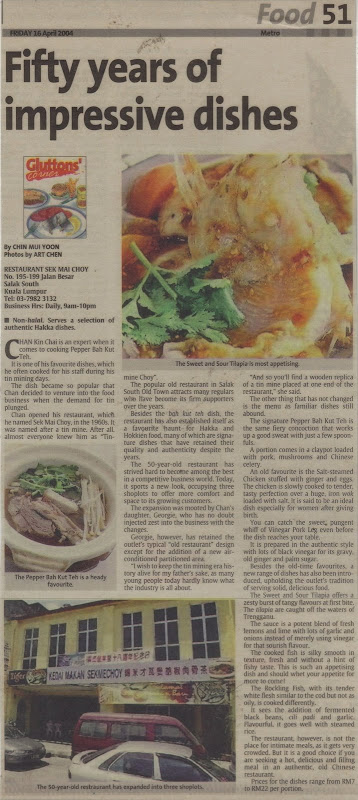
[Media Review]Fifty years of Impressive dishes (16 April 2004)

Fifty years of Impressive dishes (16 April 2004)
By Chin Mui Yoon
Photos by Art Chen

Chan Kin Chai is an expert when it comes to cooking Pepper Bah Kut Teh.

It is one of his favourite dishes, which he often cooked for his staff during his tin mining days.

The dish became so popular that Chan decided to venture into the food business when the demand of tin plunged.

Chan opened his restaurant, which he named Sek Mai Choy, in the 1960s. it was named after a tin mine. After all, almost everyone knew him as “Tin-Mine Choy”.

The popular old restaurant in Salak South Old Town attracts many regulars who have become its firm supporters over the years.

Besides the bah kut teh dish, the restaurant has also established itself as a favourite haunt for Hakka and Hokkien food, many of which are signature dishes that have retained their quality and authenticity despite the years.

The 50-year-old restaurant has strived hard to become among the best in a competitive business world. Today, it sports a new look, occupying three shop lots to offer more comfort and space to its growing customers.

The expansion was mooted by Chan’s daughter, Georgie, who has no doubt injected zest into the business with the changes.

Georgie, however, has retained the outlet’s typical “old restaurant” design except for the addition of a new air-conditioned partitioned area.

“I wish to keep the tin mining era history alive for my father’s sake, as many young people today hardly know what the industry is all about. ”

“And so you’ll find a wooden replica of a tin mine placed at one end of the restaurant,” she said.

The other thing that has no changed is the menu as familiar dishes still abound.

The signature Pepper Bah Kut Teh is the same fiery concoction that works up a good sweat with just a few spoonfuls.

A portion comes in claypot loaded with pork, mushrooms and Chinese celery.

And old favourites is the Salt-steamed Chicken stuffed with ginger and eggs. The chicken is slowly cooked to tender, tasty perfection over a huge, iron wok loaded with salt. It is said to be an ideal dish especially for women after giving birth.

You can catch the sweet, pungent whiff of Vinegar Pork Leg even before the dish reaches your table.

It is prepared in the authentic style with lots of black vinegar for its gravy, old ginger and palm sugar.

Besides the old-time favourites, a new range of dishes has also been introduced, upholding the outlet’s tradition of serving solid, delicious food.

The Sweet and Sour Tilapia offers a zesty burst of tangy flavours at first bite. The tilapia are caught off the waters of Trengganu.

The sauce is a potent blend of fresh lemons and lime with lots of garlic and onions instead of merely using vinegar for that sourish flavour.

The cooked fish is silky smooth in texture, fresh an without a hint of fishy taste. This is such an appetizing dish and should whet your appetite for more to come!

The Rockling Fish, with its tender white flesh similar to the cod but not as oily, it cooked differently.

It sees the addition of fermented black beans, cili padi and garlic. Flavourful, it goes well with steamed rice.

The restaurant, however, is not the place for intimate meals, as it gets very crowded. But it is a good choice if you are seeking a hot, delicious and filling meal in an authentic, old Chinese restaurant.

Price for the dishes range from RM7 to RM22 per portion.

[媒体访问]锡米才芥菜饭,一天只卖一大锅


锡米才芥菜饭,一天只卖一大锅
一家餐厅开了十多年,算不算老招牌?从1986年开始营业的“锡米才瓦煲肉骨茶”,至今已有16年的“历史”,顾客更是一代接一代,大人小孩都是老顾客。

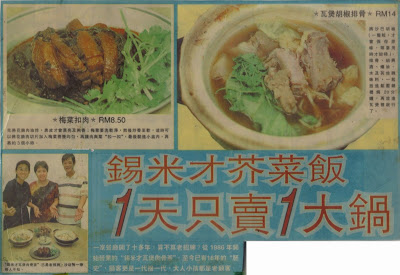
梅菜扣肉 RM8.50
先将花腩肉油炸,表皮才会漂亮及够香;梅菜要洗干净,然后炒香至软,这时可以将花腩肉切片加入梅菜里搅均匀,再让肉与菜“扣一扣”,最后装入小盅内,再蒸约3个小时。

瓦煲胡椒排骨 RM14
将沙巴胡椒(一整粒,才会保存原味,等要用时才绞碎)、排骨、绍兴酒、蚝油、水及其他调味料,一起放入气压锅里局20分钟,再放进瓦煲里就行了。

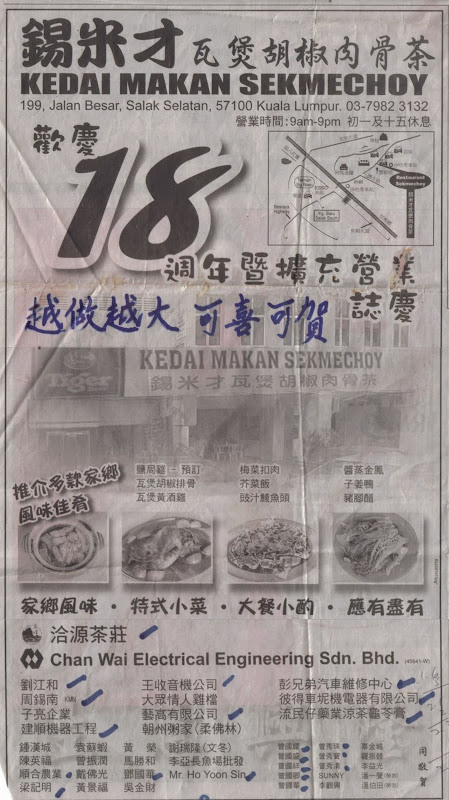
[广告]锡米才欢庆18周年纪念暨扩充营业

光明肉骨茶争霸赛

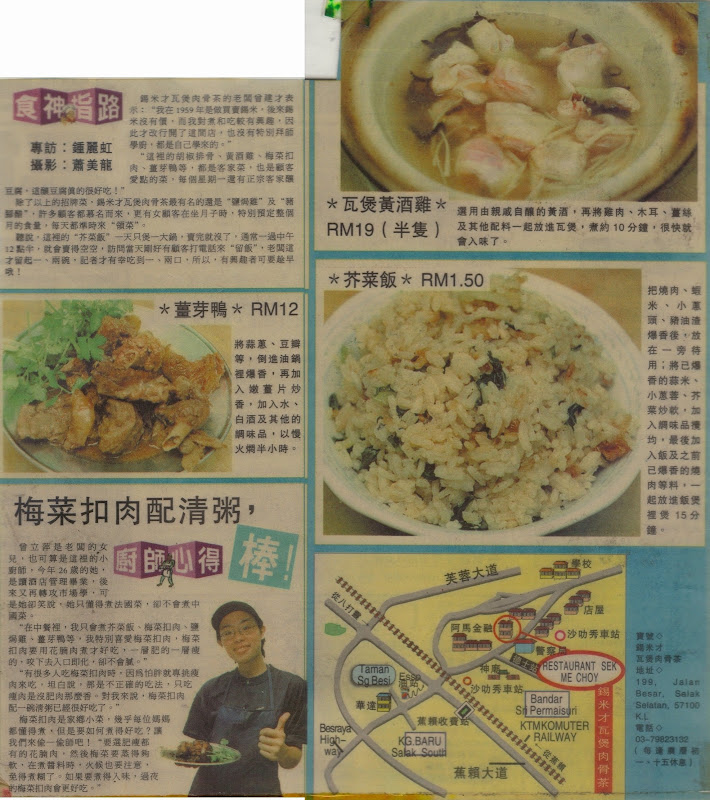
[媒体访问]食神指路

食神指路
专访:钟丽红
摄影:萧美龙

锡米才瓦煲肉骨茶的老板曾建才表示:“我在1959年是做买卖锡米,后来锡米没有价,而我对煮和吃较有兴趣,因此才改行开了这间店,也没有特别拜师学厨,都是自己学来的。”

“这里的胡椒排骨、黄酒鸡、梅菜扣肉、姜芽鸭等,都是客家菜,也是顾客爱点的菜,每个星期一还有正宗客家酿豆腐,这酿豆腐真的很好吃!”

除了以上的招牌菜,锡米才瓦煲肉骨茶最有名的还是“盐局鸡”及“猪脚醋”,许多顾客都慕名而来,更有女顾客在坐月子时,特别预定整个月的食量,每天都准时来“领菜”。

听说,这里的“芥菜饭”一天只煲一大锅,通常一过中午12点半,就会卖得空空,访问当天刚好有顾客打电话来“留饭”,老板才留起一、两碗,记者才有幸吃到一、两口,所以,有兴趣者可要趁早哦!

瓦煲黄酒鸡RM19(半只):选用由亲戚自酿的黄酒,再将鸡肉、木耳、姜丝及其他配料一起放进瓦煲,煮约10分钟,很快就会入味了。

姜芽鸭RM12:将蒜葱、豆瓣等,到进油锅里爆香,再加入嫩姜片炒香,加入水、白酒及其他的调味品,以慢火焖半小时。

芥菜饭RM1.50:把烧肉、虾米、小葱头、猪油渣爆香后,放在一旁待用;将已爆香的蒜米、小葱蓉、芥菜炒软,加入调味品搅均,最后加入饭及之前已爆香的烧肉等料,一起放入饭煲里煲15分钟。

厨师心得:
梅菜扣肉配清粥,棒!
曾立萍是老板的女儿,也可算是这里的小厨师。今年26岁的她,是读酒店管理毕业,后来又再转攻市场学,可是她却笑说,她只懂得煮法国菜,却不会煮中国菜。
“在中餐里,我只会煮芥菜饭、梅菜扣肉、盐局鸡、姜芽鸡等,我特别喜爱梅菜扣肉,梅菜扣肉要用花腩肉煮才好吃,一层肥的一层瘦肉,咬下去入口即化,却不会腻。”
“有很多人吃梅菜扣肉时,因为怕胖就专挑瘦肉来吃,坦白说,那是不正确的吃法,只吃瘦肉是没肥肉那么香。对我来说,梅菜扣肉配一碗清粥已经很好吃了。”
梅菜扣肉是家乡小菜,几乎每位妈妈都懂得煮,但是要如何煮得好吃?让我们来偷一偷师吧!“要选肥瘦都有的花腩肉,然后梅菜要蒸得够软,在煮酱料时,火候也要注意,免得煮糊了。如果要煮得入味,过夜的梅菜扣肉会更好吃。”

[Media Review]Sweating it out on pepper (Star Metro August 30, 2002)

(Click to Enlarge)

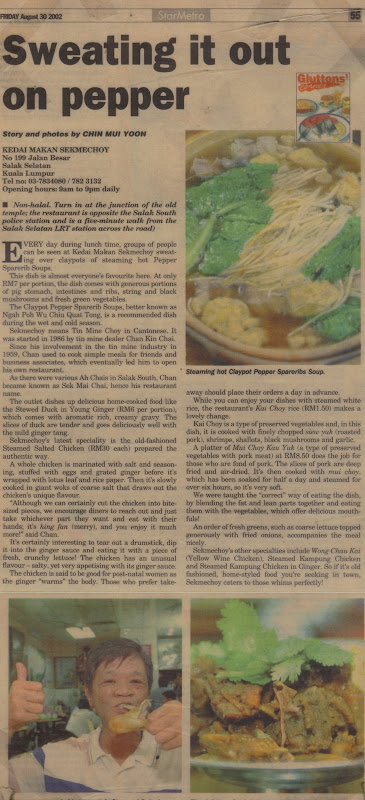
Sweating it out on pepper (Star Metro August 30, 2002)
Story and photos by CHIN MUI YOON

KEDAI MAKAN SEKMECHOY
No 199 Jalan Besar
Salak Selatan
Kuala Lumpur
Tel No: 03-783 4080 / 782 3132
Opening hours: 9am to 9pm daily

Non-halal. Turn in at the junction of the old temple; the restaurant is opposite the Salak South police station and is a five-minute walk from the Salak Selatan LRT station across the road.

Every day during lunch time, groups of people can be seen at Kedai Makan Sekmechoy sweating over claypots of steaming hot Pepper Sparerib Soups.

The dish is almost everyone’s favourite here. At only RM7 per portion, the dish comes with generous portions of pig stomach, intestines and ribs, string and black mushrooms and fresh green vegetables.

The Claypot Pepper Sparerib Soups, better known as Ngah Poh Wu Chiu Quat Tong, is a recommended dish during the wet and cold season.

Sekmechoy means Tin Mine Choy in Cantonese. It was started in 1986 by tin mine dealer Chan Kin Chai.
Since his involvement in the tin mine industry in 1959, Chan used to cook simple meals for friends and business associates, which eventually led him to open his own restaurant.

As there were various Ah Chais in Salak South, Chan became known as Sek Mai Choi, hence his restaurant name.

The outlet dishes up delicious home-cooked food like the Stewed Duck in Young Ginger (RM6 per portion), which comes with aromatic rich, creamy gravy. The slices of duck are tender and goes deliciously well with the mild ginger tang.

Sekmechoy’s latest speciality is the old-fashioned Steamed Salted Chicken (RM30 each) prepared the authentic way.

A whole chicken is marinated with salt and seasoning, stuffed with eggs and grated ginger before it’s wrapped with lotus leaf and rice paper. Then it’s slowly cooked in giant woks of coarse salt that draws out the chicken’s unique flavour.

“Although we can certainly cut the chicken into bite-sized pieces, we encourage diners to reach out and just take whichever part they want and eat with their hands; it’s hing fun (merry), and you enjoy it much more!” said Chan.

It’s certainly interesting to tear out a drumstick, dip it into the ginger sauce and eating it with a piece of fresh, crunchy lettuce! The chicken has an unusual flavour – salty, yet very appetizing with its ginger sauce.

The chicken is said to be good for post-natal women as the ginger “warms” the body. Those who prefer take-away should place their orders a day in advance.

While you can enjoy your dishes with steamed white rice, the restaurant’s Kai Choy rice (RM1.50) makes a lovely change.

Kai Choy is a type of preserved vegetables and, in this dish, it is cooked with finely chopped siew yuk (roasted pork), shrimps, shallots, black mushrooms and garlic.

A platter of Mui Choy Kau Yuk (a type of preserved vegetable with pork meat) at RM8.50 does the job for those who are fond of pork. The slices of pork are deep fried and air-dried. It’s then cooked with mui choy, which has been soaked for half a day and steamed for over six hours, so it’s very soft.

We were taught the “correct” way of eating the dish, by blending the fat and lean parts together and eating then with vegetables, which offer delicious mouthfuls.

An order of fresh greens, such as coarse lettuce topped generously with fresh onions, accompanies the meal nicely.

Sekmechoy’s other specialties include Wong Chau Kai (Yellow Wine Chicken), Steamed Kampung Chichen and Steamed Kampung Chicken in Ginger. So if it’s old fashioned, home-styled food you’re seeking in town, Sekmechoy caters to those whims perfectly!